
House Extension Costs in Derbyshire 2026: A Realistic Guide
What Does a High-End House Extension Actually Cost in Derbyshire in 2026?
A well-specified single-storey extension in Derbyshire and the wider Midlands typically costs somewhere between £1,600 and £3,500 per square metre in 2026, depending on specification, with premium, architecture-led projects sitting at the upper end of that range. A 40m² extension at that level lands broadly between £88,000 and £140,000 for the build alone, before fees and finishes are added. Here's how those numbers actually break down, and what tends to move them.
Why "It Depends" Is the Honest Starting Point
Any figure quoted without context is, at best, a rough steer — extension costs are shaped by specification, extension type, site access, structural complexity and location, often by tens of thousands of pounds on a single project. What follows is a genuine attempt to break that down rather than collapse it into one misleadingly precise number.
Cost by Specification Level
For a single-storey rear extension — the most common project type — current UK build costs cluster into three broad bands:
- Budget specification: roughly £1,200–£1,600/m². Standard finishes, straightforward glazing, no significant structural complexity.
- Mid-range specification: roughly £1,600–£2,200/m². Better-quality glazing and finishes, some bespoke joinery, moderate structural intervention.
- Premium, architect-led specification: roughly £2,200–£3,500/m². Large-format glazing, underfloor heating, high-quality natural materials, bespoke detailing, and the level of structural and technical coordination a genuinely considered design usually requires.
Most of the projects we're asked about by clients targeting a high-end result sit at the top of that range, or above it once bespoke joinery, natural stone or timber, and integrated technology are specified in full.
Cost by Extension Type
The type of extension matters as much as the specification level:
- Single-storey rear: the baseline figures above.
- Side return: typically £1,800–£2,800/m², reflecting tighter site access and often more complex structural work to open up the existing plan.
- Wrap-around: typically £1,700–£2,600/m², combining a rear and side extension into one continuous space.
- Double-storey rear: typically £1,200–£2,000/m² at mid-range specification — often better value per square metre than a single-storey equivalent, since it doesn't duplicate roof and foundation costs across two separate builds.
- Over-garage: typically £1,000–£1,800/m², usually the most cost-efficient route to significant additional floor area where an existing garage footprint allows it.
Where Derbyshire and the Midlands Sit Nationally
Location moves the numbers more than most people expect. London build costs currently run around 35% above the Midlands baseline for equivalent specification, while the North East and Wales tend to sit 10–15% below it. Derbyshire and the wider Midlands sit in a genuinely favourable middle position: specification and ambition aren't materially constrained by geography here, but budgets stretch noticeably further than they would for an equivalent scheme in London or the South East — a meaningful advantage for anyone weighing up where to build or extend.
What's Not Included in the £/m² Figure
The build cost per square metre covers construction only. A realistic project budget also needs to account for:
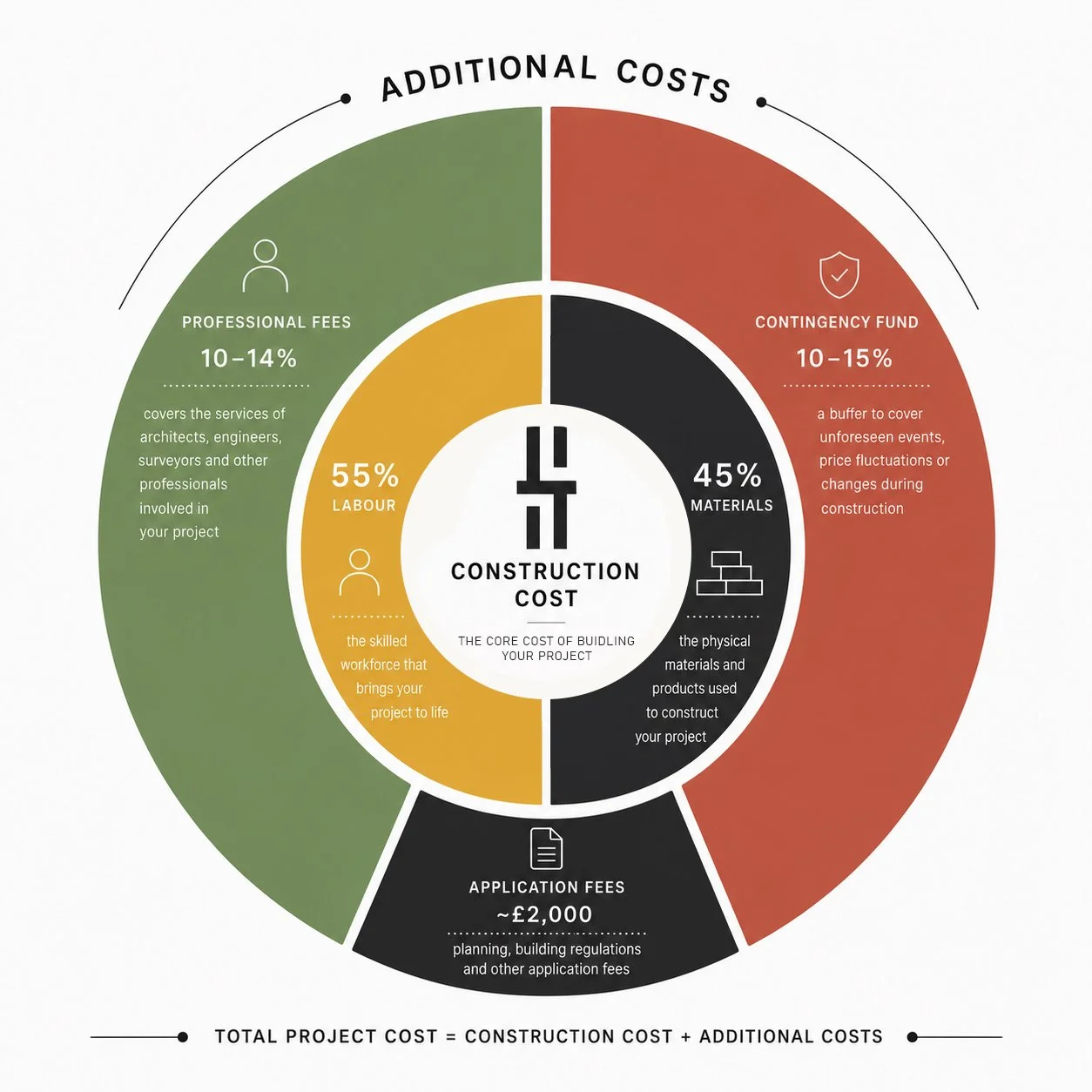
- Architectural and Structural design team fees. For extensions specifically, professional fees typically run higher than for new-build houses — typically in the region of 10–12% of the construction cost, reflecting the added complexity of designing around and structurally tying into an existing building, versus the comparative simplicity of a clean site.
- Planning and Building Regulations application fees.
- A party wall surveyor where a shared boundary is involved.
- A contingency. For extension and renovation work — where existing structures inevitably reveal a surprise or two once opened up — a contingency of 10–15% of build cost is a realistic minimum, not an optional extra.
- Furniture, loose fittings and landscaping, which are easy to underestimate and rarely included in a builder's quote.
A Worked Example
To make this concrete: take a 40m² single-storey rear extension, specified at the premium end (£2,800/m² as a mid-point of that band) — a reasonable proxy for a high-end kitchen/family space with large-format glazing and very high quality finishes.
- Build cost: 40m² × £2,800/m² = £112,000
- Architectural and Structural design team fees (11%, mid-point of the 10–12% range): ≈ £12,320
- Building Regulations and planning fees: ≈ £1,500–£2,000
- Contingency (12.5%, mid-point of 10–15%): ≈ £14,000
- Realistic total budget: roughly £140,000, before furniture, loose fittings or garden works.
Extending a listed building follows the same logic with higher fees throughout — typically 12–14% rather than 10–12% — reflecting the additional conservation input, consultation with the local conservation officer, and often more specialist detailing and extensive materials research involved.
Getting a Number You Can Actually Trust
The only way to move from a price per-square-metre range to a number worth planning a budget around is to have a specific site, a specific brief and a specific specification looked at together — which is precisely what the early stages of appointing an architect are designed to do, before any construction cost is committed to. A ballpark figure is a useful starting point for a conversation; it's a poor substitute for one.
Frequently Asked Questions
How much does a single-storey extension cost in Derbyshire in 2026?
For a well-specified, architect-led project, typically £2,200–£3,500 per square metre, meaning a 40m² extension would cost roughly £88,000–£140,000 for the build alone, before fees. If you’re looking for a more straightforward extension with minimal structural intervention and finished to a budget level specification, we’ve seen similar sized projects completed for under £60,000 - minus fees.
Are extensions cheaper than building a new house per square metre?
Not necessarily — extension costs are often comparable to or higher than new-build costs per square metre, because working around and tying into an existing structure adds complexity that a clean site doesn't have. This also shows up in architect fees, which tend to run higher for extensions than for new houses.
Is it cheaper to build in Derbyshire than in London?
Yes, materially. Current build costs in London run around 35% above the Midlands baseline for equivalent specification, meaning budgets in Derbyshire and the wider Midlands generally stretch further for the same level of ambition.
What percentage should I budget for professional fees on an extension?
Everyone is going to price slightly differently, but it’s sensible to budget somewhere in the region of 10–14% of construction cost for full architectural and structural services on an extension, varying with project value and complexity — towards the upper end of that range for work involving a listed building.
How much contingency should I include in an extension budget?
A minimum of 10–15% of build cost is realistic for extension and renovation work, where opening up an existing structure often reveals something the original drawings couldn't show.
Figures above are current UK-wide and regional benchmarks rather than a quote for any specific project — every site and brief is different, and the only way to get a number worth relying on is to talk through yours directly. Get in touch to start that conversation.