
If your plot sits inside the Peak District Dales or River Mease catchments — two of the twenty-seven protected river catchments across England where "nutrient neutrality" rules apply — a planning application for a new home will need to show that it won't add extra phosphorus to the water, almost always by paying for mitigation elsewhere before permission is granted. If you're only extending an existing house rather than creating a new one, the rule is considerably less likely to reach you at all: in the Peak District Dales catchment specifically, the two authorities responsible for it have confirmed in writing that householder extensions don't need to demonstrate nutrient neutrality.
That's the short version. The longer version matters more, because nutrient neutrality is one of those rules that can sit quietly in the background of a plot's planning history for years, then surface at exactly the wrong moment — after the land is bought, the drawings commissioned, and the design already loved.
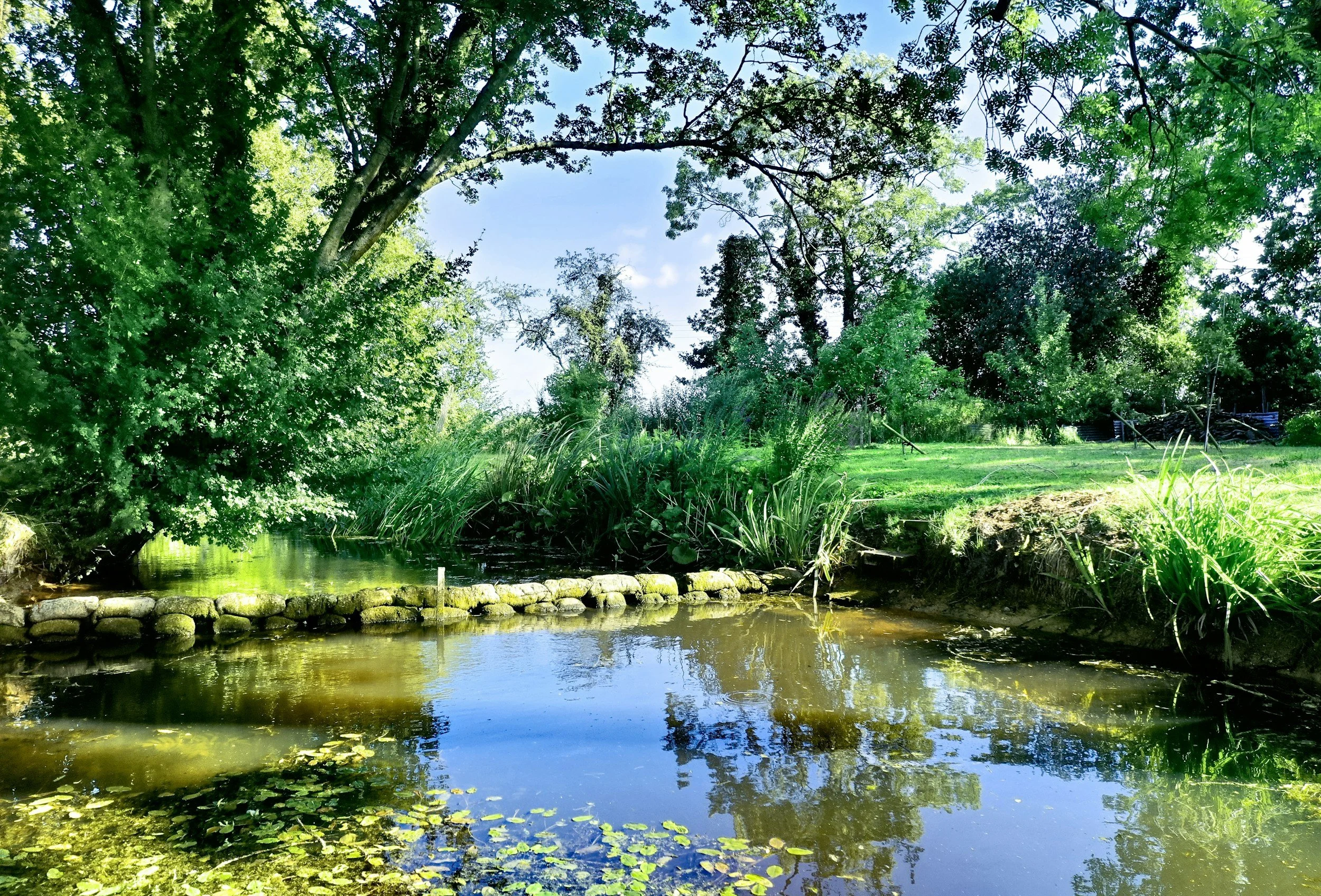
What Is Nutrient Neutrality, in Plain Terms?
Some rivers and wetlands in England are protected under habitats law, often as Special Areas of Conservation, because of what lives in and around them. A number are already carrying more phosphorus or nitrogen than they can comfortably absorb, largely from agriculture and wastewater treatment works. Every new home adds a little more to that load — not through anything dramatic, just the ordinary business of showering, washing up and flushing a toilet, because even treated wastewater still carries nutrients downstream.
Where a protected river is already overloaded, Natural England requires new development in that catchment to be "nutrient neutral": the extra nutrient load a development would cause has to be fully offset, usually by paying into, or creating, habitat elsewhere that locks up an equivalent amount of phosphorus or nitrogen. Without that offset secured, planning permission for a new dwelling in the catchment can't lawfully be granted.
The requirement currently covers 27 river catchments and 31 protected sites, across dozens of local planning authorities in England.
Which Parts of Our Territory Does This Actually Touch?
Two catchments sit close to home, though neither maps neatly onto a single familiar boundary. The Peak District Dales catchment — referred to in some council documents as the Derbyshire Dales Special Area of Conservation, the same underlying protected river system under a different name — is the one High Peak Borough Council runs its own mitigation scheme for, and the Peak District National Park Authority's own guidance treats it the same way, so it clearly reaches sites within the National Park boundary and within High Peak borough. We couldn't find a single authoritative source confirming its full administrative reach beyond that, so if you're looking at land in Derbyshire Dales district outside the Park boundary — in principle, that includes Brailsford itself — the honest answer is to ask the relevant council directly rather than assume either way. A plot near Buxton, Tideswell, Litton or elsewhere in the limestone dales sits more obviously inside it.
The River Mease catchment, over towards the Leicestershire and Staffordshire border, spans South Derbyshire, Lichfield, North West Leicestershire and North Warwickshire — worth knowing if a client's search for land has drifted into that corner of the wider East Midlands.
Crucially, both catchments are defined hydrologically, not by postcode or council boundary. Two plots a few hundred metres apart can sit on opposite sides of the line. The only reliable way to check is Natural England's own catchment map, or a direct question to the relevant planning authority — never an assumption based on which district a plot happens to fall in.
Does It Apply to a Single Self-Build Home?
Yes, in principle, in exactly the same way it applies to a housing estate — the legal test doesn't distinguish by size. A single new dwelling, including a self-build, is expected to run the same nutrient calculation as a 200-home scheme; the resulting budget is simply smaller, and the mitigation cheaper to buy.
In practice, that means running Natural England's nutrient calculator for the site, submitting the output with the planning application, and having the council consult Natural England on it before permission can be granted. The calculator defaults to assuming 2.4 people will occupy the finished home, and — where the site can't connect to mains sewerage — factors in a septic tank or package treatment plant, which then needs its own maintenance regime secured through the planning process.

What About Extending an Existing House?
This is the question we're asked most often, and it's where the Peak District Dales catchment gives a genuinely reassuring answer. High Peak Borough Council's own published guidance lists "householder extensions" as exempt outright, alongside like-for-like replacement dwellings — where bedroom count can rise without the number of dwellings changing — and commercial development with no overnight stays. In other words, extending your home in the Peak District Dales catchment, even substantially, isn't currently treated as triggering a fresh nutrient calculation.
We'd stop short of promising that holds everywhere nutrient neutrality applies. National guidance on the calculators doesn't address extensions one way or the other, which suggests the exemption we found reflects a position this catchment's authorities have taken, rather than a blanket national rule. If your project sits in the River Mease catchment, or any other nutrient-neutrality catchment, the honest answer is to put the same question to the council directly rather than assume the same exemption applies.
How Do You Mitigate It, and What Does That Cost?
Where a new dwelling can't avoid the calculation, and does show a net nutrient increase, there are broadly two routes. You can secure mitigation yourself — improving a package treatment plant, creating a wetland or buffer strip, or taking agricultural land out of use on land you control — secured through a Section 106 agreement, since planning conditions alone can't secure anything off-site. Or, where a council runs one, you can buy credits from a strategic mitigation scheme instead of sourcing your own.
As it stands, the second route isn't yet available in the Peak District Dales catchment. The two authorities have been working through options for a joint credit scheme, but pricing and availability "will be published before sales begin," with no launch date confirmed. For now, that leaves on-site mitigation or a bespoke Section 106 arrangement as the practical route for a self-build client there.
For a sense of scale, the authorities' own feasibility work gives an idea of how differently priced various mitigation methods can be, modelled across a theoretical 1,829 dwellings: upgrading a package treatment plant works out at roughly £730 per dwelling in that model, a constructed wetland around £1,050, taking agricultural land out of production over £7,000, and the most expensive options — paying farmers to give up fertiliser altogether — run into six figures per dwelling. These are illustrative, strategic-scale unit costs from a council feasibility model, not a quote any individual would be given; what an actual mitigation package costs depends entirely on the site and the method chosen, and needs pricing specific to the project.
Is Any of This About to Change?
Possibly, eventually. Under the Planning and Infrastructure Act 2025, government is rolling out "Environmental Delivery Plans" — a mechanism where developers pay a fixed per-home levy into a national Nature Restoration Fund instead of running their own bespoke nutrient calculation, with Natural England handling mitigation at landscape scale instead. The first of these, covering the River Wensum and the Broads in Norfolk, went out for consultation in September 2026 and closed on 27 October 2026, with Natural England recommending it passes its own "Overall Improvement Test." No decision has been published yet.
Nothing comparable is currently proposed for the Peak District Dales or River Mease. If the Norfolk plan is approved, its approach may eventually be extended elsewhere — but until that happens, both catchments continue to run on the existing scheme-by-scheme calculation and mitigation process described above.

What Should You Do Before You Buy a Plot?
Treat nutrient neutrality the way you'd treat flood risk or an Article 4 direction: a due-diligence question to settle before falling for a site, not after. Check Natural England's catchment map, ask the local planning authority directly whether the site falls within the Peak District Dales or River Mease catchment, and — if it does — ask what mitigation route is actually available right now, rather than assuming a credit scheme exists. For an existing house you're planning to extend rather than replace, the Peak District Dales position suggests there may be considerably less to worry about than the site's wider planning history might imply — worth confirming with the council in writing all the same, rather than simply assuming it.
Frequently Asked Questions
What is nutrient neutrality?
A planning requirement, used in protected river catchments where pollution levels are already too high, that a new home's extra nutrient load — mainly phosphorus or nitrogen from wastewater — must be fully offset before permission can be granted.
Does nutrient neutrality apply to house extensions?
In the Peak District Dales catchment, no — High Peak Borough Council and the Peak District National Park Authority explicitly exempt householder extensions. Other catchments may take a different view, so it's worth confirming directly if your project sits elsewhere.
How do I know if my plot is affected?
Check Natural England's nutrient neutrality catchment map and ask your local planning authority directly. Catchment boundaries follow river hydrology rather than postcodes or council borders, so two neighbouring plots can have different answers.
Is there a cost to mitigate nutrient neutrality for a single self-build home?
Yes, if your site needs it — though the cost depends heavily on the site and the mitigation method available. A council-run credit scheme, where one exists, tends to be the simplest route; without one, mitigation has to be arranged and secured individually, usually through a Section 106 agreement.
Could nutrient neutrality rules be scrapped or changed soon?
Government is trialling a replacement mechanism, Environmental Delivery Plans, starting with a Norfolk pilot — but nothing equivalent is yet proposed for the Peak District Dales or River Mease catchments, so the current rules remain in force there for now.