
What Is "Grey Belt" in Planning — and Where Does It Apply?
Grey belt is a category of Green Belt land — introduced into national planning policy in December 2024, and refined further in August 2026 — that can be released for housing more readily than Green Belt generally, because it no longer does much of the job Green Belt is meant to do. It isn't a place on a map you can look up, and it isn't every field on the edge of a town. It's a specific legal test, applied case by case, and getting it right or wrong is the difference between a plot with genuine potential and one that only looks like it has some.
We're writing about this now because it's had a real, technical change as part of the wider NPPF rewrite that took effect on 17 August 2026 — separate from the update on the rewrite generally we published alongside this piece — and because it comes up often enough with clients looking for a self-build plot near the Derby and Nottingham fringe of our own county that it's worth a proper, careful explanation.
What exactly is grey belt land?
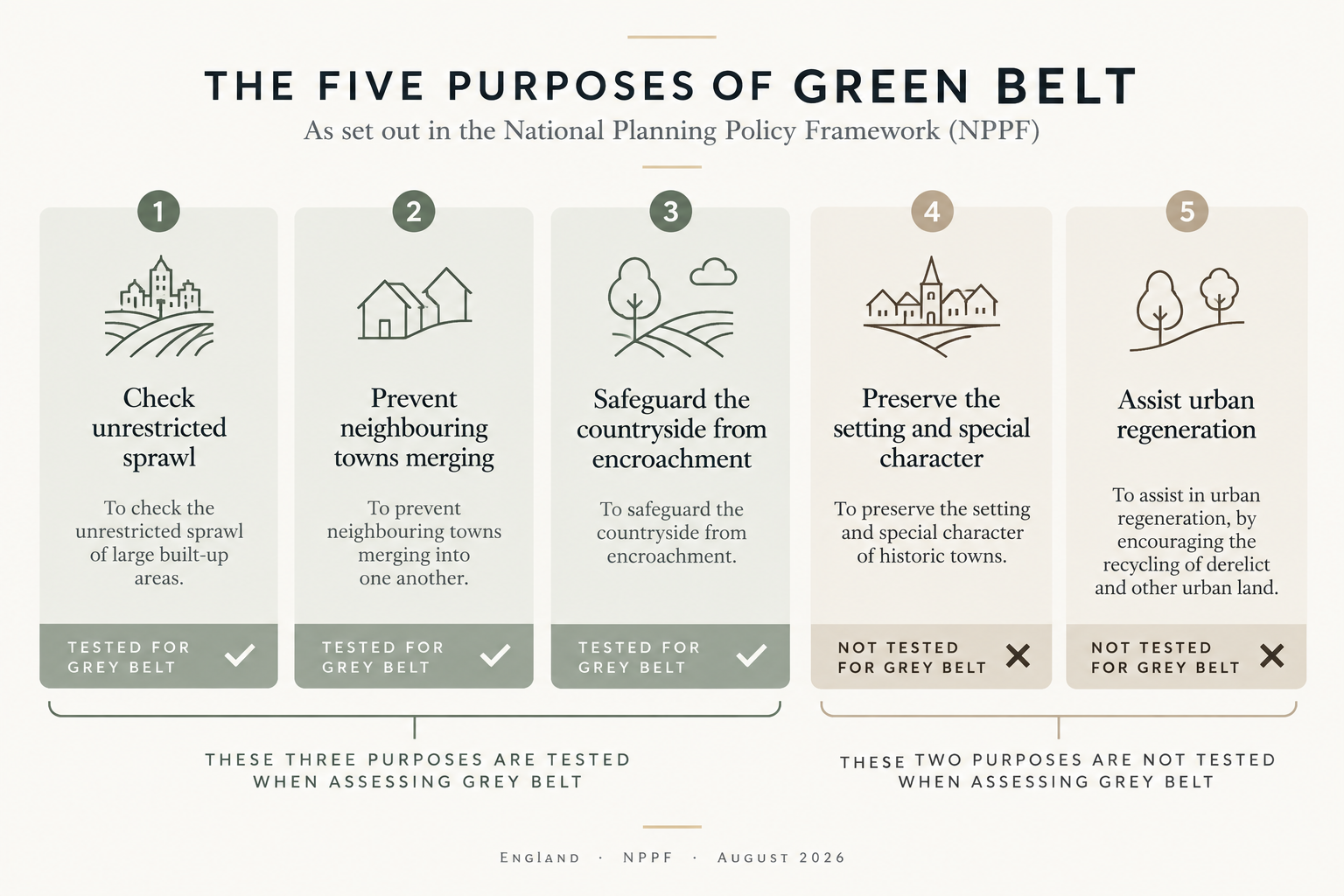
National planning policy has always protected the Green Belt by reference to five purposes: checking the unrestricted sprawl of large built-up areas, preventing neighbouring towns merging into one another, safeguarding the countryside from encroachment, preserving the setting and special character of historic towns, and assisting urban regeneration by recycling derelict land. Grey belt status asks a narrower question: does this specific piece of land — because it's previously developed, or simply because of where and what it is — strongly contribute to only three of those five purposes: preventing sprawl, preventing towns merging, or preserving a historic town's setting? If the answer is no, it can be classified as grey belt, regardless of how it performs against the other two purposes.
That's a deliberately technical test, and it's worth being precise about what it doesn't mean. It doesn't mean the land is unattractive, unused, or unimportant to local people. It doesn't mean planning permission follows automatically. It means one particular gate, in a much longer sequence of tests, opens more easily than it would for Green Belt land generally.
What changed for grey belt in August 2026?
The most consequential change is a narrowing of what disqualifies land from grey belt status in the first place. Previously, a site couldn't be classified as grey belt at all if a separate set of protections — covering heritage, landscape, habitat or flood risk — would give a strong reason to refuse development on it. That exclusion has been removed. Classification and acceptability are now treated as two separate questions: a site can be identified as grey belt even where it also carries a heritage or landscape constraint, with that constraint weighed later, in the ordinary planning balance, rather than blocking the classification at the first hurdle.
In practice, that widens what qualifies as grey belt at the point of classification, even though the tests that follow — whether releasing the land would fundamentally undermine what remains of the Green Belt, whether there's a demonstrated need for the development, whether the location is genuinely sustainable — are unchanged and still demanding. The government also formalised its assessment methodology in the Framework's technical annexes, and widened a separate route that lets Green Belt boundaries move for development near well-connected railway stations. None of this is a wholesale loosening of Green Belt protection. It's a more precisely drawn gate, opened slightly further than it was two years ago.
Does this affect Derbyshire and the Peak District?
Less than you might expect, geographically. The Peak District National Park has its own, entirely separate and generally stronger protection regime — it isn't Green Belt, so grey belt status has no bearing on it at all. Green Belt land proper covers only a small share of Derbyshire, concentrated in the Nottingham and Derby Green Belt, which reaches into the districts of Amber Valley, Erewash and South Derbyshire on the county's eastern edge. If your plot or project is anywhere else in the county, grey belt is simply the wrong question to be asking.
Where it does apply, it's already being tested in practice, not just in theory. In February 2025, Erewash Borough Council approved a scheme of up to around 260 homes on land near Spondon, on the edge of Derby, with grey belt reasoning forming part of the case — officers argued the site didn't strongly contribute to preventing sprawl or the merging of settlements, given how self-contained and how far from the nearest other town it actually was. It's a live illustration that this isn't an abstract national policy argument; it's already shaping real decisions a few miles from where we work.
What does grey belt actually unlock, and for whom?
Nationally, the pattern in decided cases so far is more favourable to applicants than the coverage of a handful of very large, controversial schemes might suggest — and, tellingly, the single most common size of scheme in the data is not a housebuilder's estate but a single dwelling, even though it's the large sites that make the news. That matters for anyone assuming grey belt is purely a volume housebuilder's tool. It isn't, structurally — it's a test about land, not about who's applying.
It's also worth knowing what doesn't apply to a smaller project. The "Golden Rules" that come with grey belt release — chiefly a significant affordable housing contribution — are triggered only by "major development," meaning ten or more homes, or a site of half a hectare or more. A single self-build home, or a very small handful of plots, generally sits below that threshold, though a council's own local plan may still set its own smaller-scale requirements, so it's worth checking rather than assuming nothing applies at all.
What should someone looking at a specific plot actually do?
Treat "this land might be grey belt" as the start of a proper assessment, not the end of one. A redundant farm building, a disused yard, or another parcel that's genuinely previously developed gives a more concrete starting point than an attractive but entirely open field, because the evidence needed to support the purposes test is usually lighter. There is no public register of confirmed grey belt land — status is only settled through a council's own evidence base or, if refused, through an appeal — so a plot marketed with "grey belt potential" is a claim to test carefully, not a fact to take at face value, and it's worth budgeting time and professional input for the possibility of an appeal rather than assuming a first application will settle the question. This remains genuinely live, moving law — one allowed grey belt appeal has already been overturned by the High Court, and campaigners continue to argue for the definition to be tightened back up — so a current, site-specific assessment matters more here than in almost any other area of planning we advise on.
Frequently asked questions
Is grey belt the same as brownfield land?
Related, but not identical. Previously developed land is one of the two routes into grey belt status, but land can also qualify simply by failing to strongly contribute to the relevant Green Belt purposes, whether or not it was ever built on. Not all brownfield land is in the Green Belt, and not all grey belt land is brownfield.
Does grey belt status guarantee planning permission?
No. It removes one significant hurdle — the usual requirement to show "very special circumstances" before any Green Belt development is acceptable — but the site still has to pass every other ordinary test: need, sustainability, design quality, and not undermining the Green Belt that remains around it.
How do I find out if a specific plot is in the Green Belt at all, let alone grey belt?
Your local planning authority's adopted policies map, usually available on their website, shows Green Belt boundaries clearly. Whether a specific parcel within that boundary is grey belt is a separate, more involved assessment that isn't shown on any public map.
Is this relevant outside the Nottingham and Derby Green Belt?
Only if your plot is actually within a Green Belt boundary somewhere else — Green Belt covers a meaningful share of the wider East and West Midlands beyond Derbyshire, so the same test applies wherever that designation exists, just not across the region as a whole.
Should I pay more for a plot because it's described as grey belt?
Be cautious. Without a specific, evidenced assessment for that exact site, "grey belt potential" is closer to a hope than a fact, and paying a premium for it ahead of a genuine assessment is a real financial risk worth going into with your eyes open.