
Is There Really a Self-Build "Fast-Track" in the New NPPF?
No — not in the specific way it's being described in some recent coverage. Policy S5(j), part of the National Planning Policy Framework rewrite that took effect on 17 August 2026, is real, and it is genuinely relevant to anyone hoping to build outside a settlement boundary. But it doesn't mention self-build, custom-build, community-led housing or older people's housing by name, and it doesn't create "permission in principle" — a specific, separate legal mechanism that isn't invoked anywhere in the new Framework at all. What S5(j) actually does is narrower, more procedural, and — if you take the time to understand it properly — still genuinely useful. This post is that explanation.
We don't often write a post correcting something we've seen reported elsewhere, but this one seemed worth doing properly rather than letting an appealing but inaccurate version of a genuinely useful policy take hold. If you've already read that a new NPPF clause has quietly opened a fast lane for self-builders, this is the more careful version of that story.
What does Policy S5(j) actually say?
The new Framework restructures how every application outside a settlement boundary gets judged. Policy S5 sets out a specific list of situations where the presumption in favour of development — the "benefit of the doubt," roughly speaking — still applies even though a site sits outside a settlement. Most of that list is familiar: reusing an existing building, redeveloping brownfield land, small-scale infilling within a group of existing houses, sites near well-connected railway stations, rural exception sites for proven local housing need.
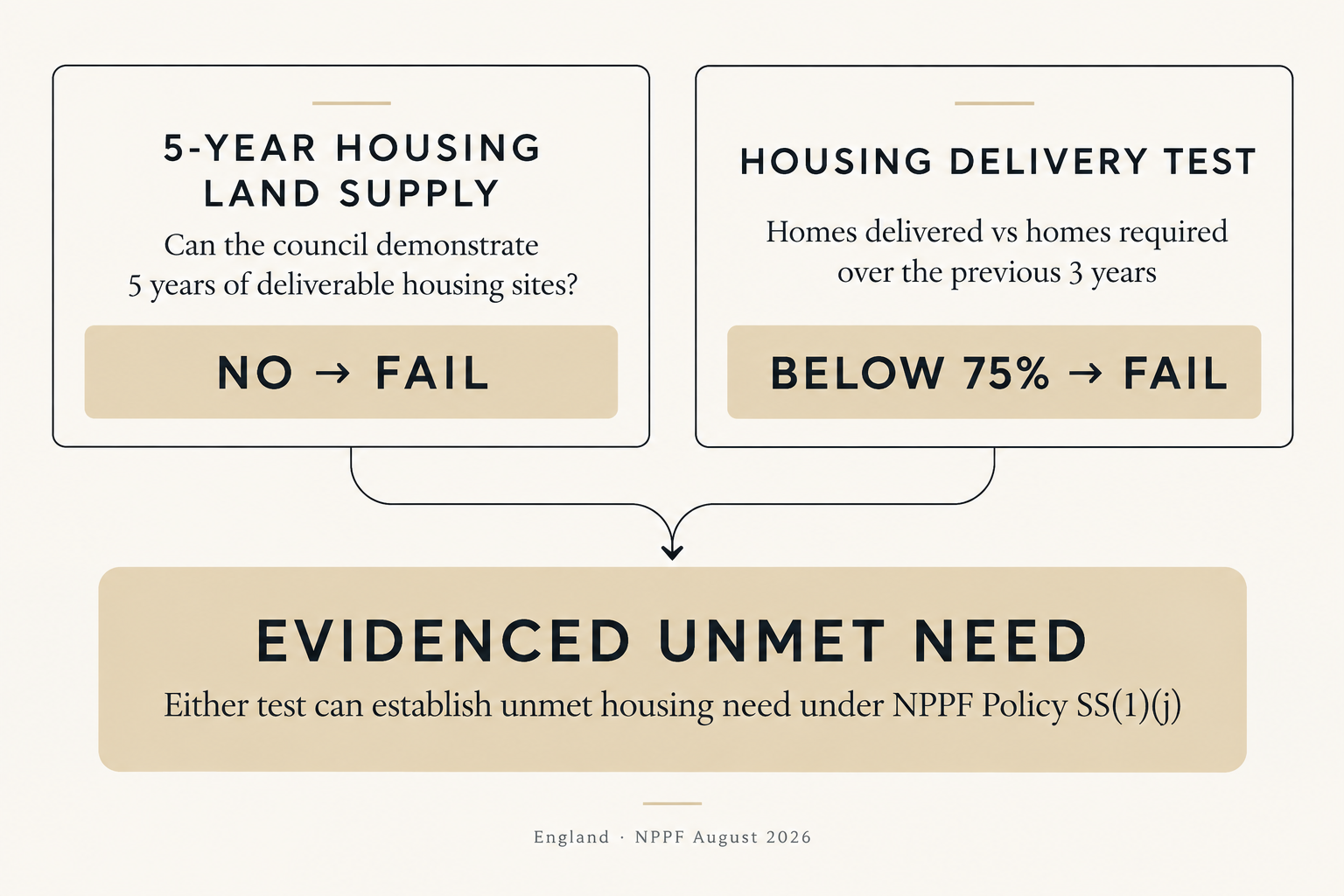
Point (j) adds a further, more open category: development that addresses "evidenced unmet need," specifically including — though the wording says "not limited to" — cases where the local council cannot demonstrate a five-year supply of deliverable housing land, or has scored below 75% on the government's most recent Housing Delivery Test. On top of that, the site still has to be "physically well-related to an existing settlement." Nowhere in that clause do the words self-build, custom-build, community-led or older people's housing appear. Those categories of housing are addressed by other, separate parts of the same Framework, and they don't route through S5(j).
So why is it being described as a self-build fast-track?
As best we can tell, that framing traces back to a single piece of commentary rather than the policy text itself, and it layers two extra claims on top of what S5(j) actually says: first, that it's specifically aimed at self-build and similar housing types, and second, that it grants "permission in principle" — a real, specific legal route (introduced by the Housing and Planning Act 2016) that lets a site get outline agreement on location and land use before a full, detailed application. We checked. The phrase "permission in principle" does not appear anywhere in the new NPPF. Permission in principle remains what it always was: something you reach via a qualifying brownfield register, a council's own local register of land, or an allocation in an adopted plan — not something a general policy about housing supply confers automatically.
We're not pointing this out to score a point. It's an easy claim to want to believe, because it would be genuinely good news for self-builders if it were true. But building a plan around a fast-track that doesn't exist is a worse outcome than working with what does.
What is "evidenced unmet need" in practice?
This is the useful part, and it's worth understanding properly rather than dismissing just because the exciting version overreached. "Evidenced unmet need" is a council-wide, published-data question, not something an individual applicant personally proves. Two figures settle it in most cases: whether your local planning authority can currently show a five-year supply of land ready for housing, and where it fell in the government's latest Housing Delivery Test, published annually. Fall below a 75% score on that test, or fail the five-year supply test, and the authority is formally in a position of "unmet need" — which matters because a meaningfully higher share of authorities are in that position than even two years ago: roughly a third failed the Housing Delivery Test in the most recent measurement round, up from around a fifth in 2023.
Practically, that means a plot's prospects under S5(j) turn on a question you can actually answer before commissioning any design work: is your local authority currently in that position? That's public information, not a matter of judgement. The site then still has to be "physically well-related to an existing settlement" — genuinely a planning judgement, not a formality, and one worth a proper pre-application conversation before relying on it. One further, honestly unresolved point: several planning barristers have noted that the "not limited to" wording in S5(j) could, in principle, extend the category further than these two named tests — but nobody has tested that reading in practice yet, through an appeal or updated guidance, so we'd treat it as a plausible argument to raise with a case officer, not a safe assumption to build a scheme on.
So is it actually useful for self-build clients?
Yes, just not as a dedicated mechanism — as one more piece of leverage in a case that still needs to be built properly on its own merits. If your council is currently missing its housing targets, a well-related site just outside a village genuinely benefits from a more favourable starting presumption than it would have under the old rules. That's real and worth knowing. It sits alongside, rather than instead of, all of the normal constraints that never went anywhere: Green Belt and grey belt status, National Park and National Landscape designations, heritage and flood-risk policy, and ordinary design quality. None of that is switched off by S5(j).
What should self-builders actually rely on?
The more concrete, better-established lever remains getting onto your local council's Self-Build and Custom Housebuilding Register — a legal requirement for every English planning authority since 2016, with a duty to grant enough permissions to match demonstrated demand. It's worth being clear-eyed about how that's going nationally: as of the most recent full year of data, roughly 65,000 individuals and over 750 groups were registered across England, permissions granted had fallen for the second year running, and the gap between registered demand and permissions actually granted has been widening rather than closing. None of that means the register isn't worth joining — it's still the clearest, most direct statement of intent a self-builder can make to their council, and authorities do have a legal duty to respond to it — but it does mean it's a campaign to run properly, with good evidence and patience, rather than a box to tick and wait.
Frequently asked questions
Does S5(j) mean I don't need to prove my own need for a self-build plot?
Correct, in the specific sense that S5(j) itself is about area-wide housing delivery data, not your personal circumstances. But a strong, individually evidenced case — ideally including registration on your council's self-build register — still strengthens any application considerably, and remains the more reliable foundation.
How do I find out if my council has failed the Housing Delivery Test or the five-year land supply test?
Both are published. The Housing Delivery Test results are released annually by the government and cover every local authority; five-year land supply positions are usually stated in a council's own local plan evidence base or housing monitoring reports, available on request or via their planning policy pages.
Is "permission in principle" worth pursuing separately, even if S5(j) doesn't grant it?
It can be, if your site is on a qualifying brownfield register or a council's local register of land, or allocated in an adopted plan or neighbourhood plan. It's a genuinely useful two-stage route in the right circumstances — just not one this particular policy hands you automatically.
Does this apply to a plot in the Peak District or another National Park?
S5's structure applies nationally, but land within a National Park carries its own, additional layer of protection on top of the ordinary countryside tests, which a favourable S5(j) position does not override. Any such site needs a specific assessment rather than a general answer.
Should I wait to see how this policy gets tested before starting my project?
Not necessarily — but it's a reason to build your case on the parts of the policy that are settled (the published data tests, the "well-related to a settlement" requirement) rather than the parts that are still genuinely open questions, and to work with a design and planning team following how this area develops in real time.