
If your extension involves work to a wall you share with a neighbour, a new wall built on or near your boundary, or excavation close to a neighbouring building's foundations, the Party Wall etc. Act 1996 will very likely apply to you. In practice, that means serving formal written notice on your neighbours before work starts — one or two months ahead, depending on the work — and, in most cases, receiving a straightforward written consent that closes the matter entirely.
That is genuinely the whole of it for most people. The Act carries a fearsome reputation among first-time extenders, largely thanks to the word "dispute" in its official guidance. In practice, it is closer to a well-designed piece of administrative housekeeping: a procedure that exists so that disagreements, if they arise at all, are resolved calmly and on paper, by independent professionals, rather than over the garden fence.

What is the Party Wall Act actually for?
The Party Wall etc. Act 1996 applies in England and Wales. It gives you a statutory right to do things you might otherwise need your neighbour's blessing for — building on the boundary, working on a shared wall, excavating close to their foundations — provided you follow its notice procedure. In return, your neighbour gets advance notice, a proper record of their property's condition before work begins, and, if needed, an independent surveyor looking after their interests. The Act has nothing to do with planning permission or Building Regulations, and it gives a neighbour no power to object to your project in principle — only a say in how the notified work is carried out.
Does the Party Wall Act apply to my extension?
The Act is triggered by three broad categories of work, and most residential extensions fall into at least one of them.
Are you working directly on a shared or party wall?
If your extension involves cutting into, raising, underpinning, thickening, or otherwise altering a wall that stands astride the boundary between your property and your neighbour's — a true party wall, most often found in terraced and semi-detached houses — notice is required. Even work as modest as cutting a chase to take the bearing of a new beam during a loft or rear extension counts.
Are you building on or astride the boundary line?
If you are building a new wall — the flank wall of an extension, say, or a garden boundary wall — up to, on, or astride the line dividing your land from your neighbour's, the Act sets out how and where it can be built, and what happens if your neighbour would rather it stayed entirely on your own land.
Are you excavating near a neighbouring building?
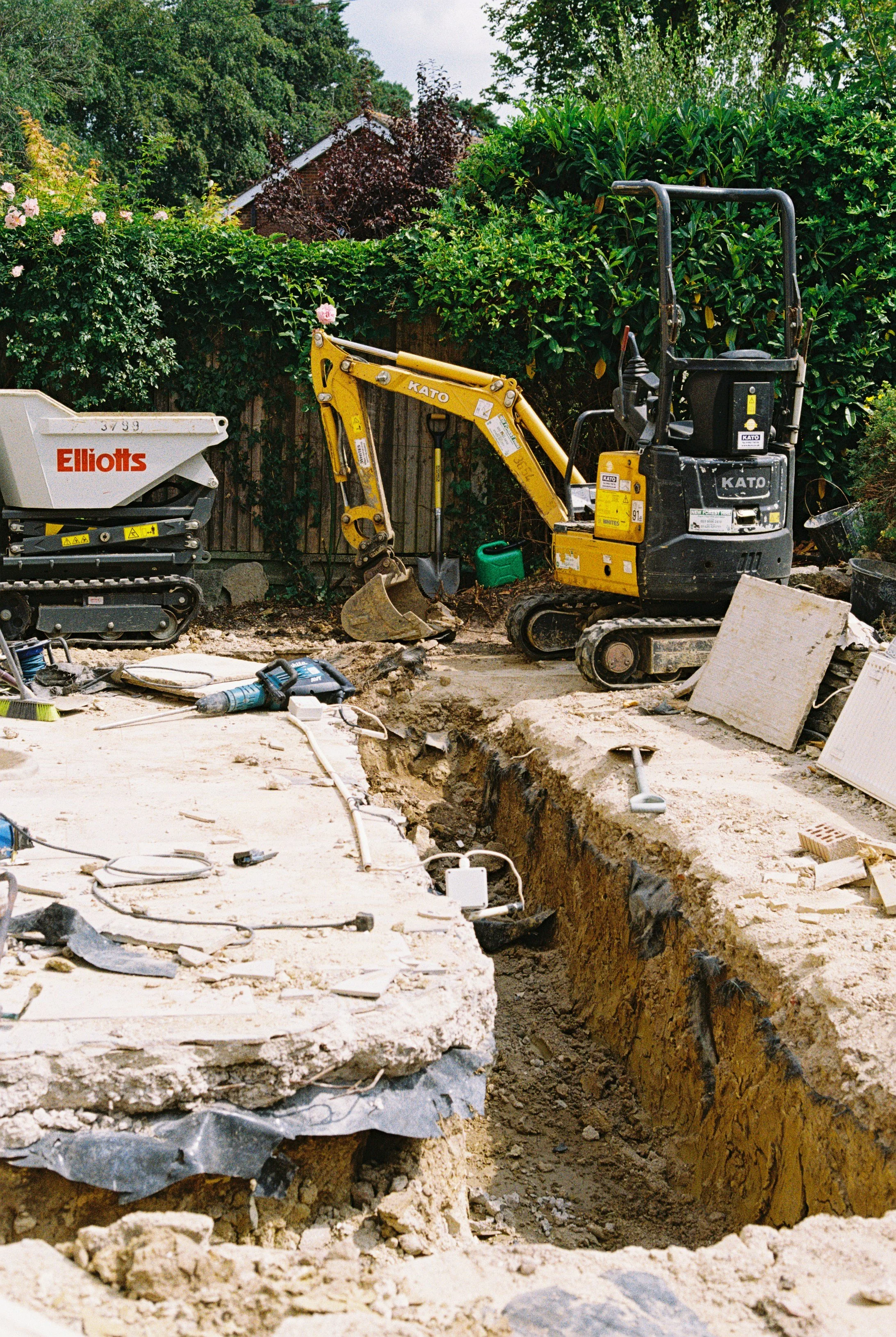
This is the category that catches people out most often. If your new foundations will fall within three metres of your neighbour's building and go deeper than their existing foundations, or within six metres and below a line projected downward at 45 degrees from the bottom of their foundations, notice is required — even if your extension never physically touches their wall. Modern trench-fill foundations, dug deep and often close to a Victorian or Edwardian neighbour's shallower footings, trigger this far more often than people expect.
What exactly counts as a "party wall"?
Not every wall near a boundary counts as a party wall. Broadly, a true party wall stands astride the boundary and forms part of both properties, or separates buildings in different ownership; a garden wall on the boundary is technically a "party fence wall," covered by similar rules. A wall standing entirely on your own land generally is not a party wall at all — and the distinction matters, because it determines exactly which notices you need to serve, and to whom.
How does the notice process work?
Notice must be in writing, setting out the work, your name and address, and your intended start date; excavation notices must also include plans and sections showing the proposed depth, and can be served by email if your neighbour is happy to accept it that way.
The required notice period depends on the work: one month for a new wall on the line of junction or for excavation, two months for work directly to an existing party wall. These are minimum periods running from valid service, not the date on the letter, so allow real breathing room rather than serving notice at the last plausible moment. Your neighbour then has fourteen days to respond in writing.
What happens if my neighbour dissents, or says nothing at all?
There are three possible outcomes, and only one of them involves any kind of formal process.
If your neighbour gives written consent, that is the end of the matter: no award is needed, and you can proceed once the notice period has run. This is what happens in most cases, particularly where the work has been explained clearly and in good time — ideally in conversation, before any formal letter arrives.
If your neighbour formally dissents, or simply does not respond within fourteen days, the Act deems a dispute to exist. This sounds more alarming than it is. It is not a veto, and it does not mean your project stalls — it simply switches on the Act's built-in resolution mechanism, so the work can still proceed lawfully and fairly, with an independent record of what was agreed.
From there, two routes are available. Both owners can agree to appoint a single "agreed surveyor," who acts impartially for both sides — often the simplest option for a straightforward domestic extension. Alternatively, each owner appoints their own surveyor, and if the two cannot agree between themselves, they jointly select a third surveyor whose decision settles the matter. Either route produces the same kind of outcome: a party wall award.
What does a party wall award actually cover?
The award — sometimes loosely called a "party wall agreement," though that is not quite its formal name — is the practical heart of the process. It sets out precisely what work will be carried out, and when and how, including any safeguards the surveyor considers necessary to protect the adjoining property. It typically includes a schedule of condition: a record of the neighbouring property's state before work starts, protecting both sides equally — your neighbour has clear evidence if anything is affected, and you have equally clear evidence if it is not. The award also sets out access arrangements and how costs are divided.
The award is final and binding on both owners unless rescinded or varied by a county court on appeal, for which either party has fourteen days from the date it is served. In practice, appeals are rare, because the process is designed to produce a fair, reasoned outcome rather than a contested one.

How much does this cost, and how long does it take?
On timing: the statutory minimums — one or two months' notice, plus the fourteen-day response window — mean a realistic minimum runway of six to ten weeks, even where your neighbour agrees straight away. Where a dispute is deemed and surveyors need to inspect, correspond and draft an award, allow closer to two or three months from first notice to signed award, longer if several neighbours are involved. None of this needs to disrupt your project if it is planned for from the outset; it only causes problems when treated as an afterthought.
On cost: the Act sets no scale of fees, and surveyors' charges vary. As a general guide, a single agreed surveyor handling a straightforward domestic matter often costs somewhere in the low hundreds to low thousands of pounds; where each side appoints their own surveyor, or a third surveyor becomes necessary, total fees are naturally higher, because you, as the person carrying out the works, are usually liable for costs on both sides. This is not a reason to dread dissent — it is simply the price of the safeguard the Act provides.
How do we support our clients through this?
We build the party wall process into the project programme from the earliest technical stages, not as a late administrative afterthought — preparing what a notice needs well ahead of your start date, talking through what to say to your neighbours before any formal letter arrives, and recommending surveyors we trust when needed. Handled this way, the process rarely causes the anxiety its reputation suggests, and it often opens an honest conversation with the people living alongside your project for months to come.
Frequently asked questions
Do I need to serve a party wall notice for a small single-storey extension?
Possibly — it is worth checking properly rather than assuming a modest extension is exempt. Even a small rear extension can trigger the excavation rules if its foundations are close to, and deeper than, your neighbour's, regardless of how small the structure above ground is.
Can my neighbour use the Act to stop my extension going ahead?
No. The Act cannot be used to object to your project in principle, on grounds of taste, privacy, or simply not wanting the disruption. Its surveyors can only require reasonable adjustments to how the notified work is carried out — not refuse the project outright.
What happens if my neighbour simply ignores my notice?
After fourteen days without a response, a dispute is automatically deemed to exist, which triggers the surveyor process rather than stalling your project indefinitely. It is a safety net for both sides, not a dead end.
Who ends up paying for the surveyors?
Where works are solely for your benefit, as most extensions are, you as the building owner are usually responsible for reasonable fees on both sides, whether that means one agreed surveyor or two.
Does the Party Wall Act apply to a project in Jersey or the Channel Islands?
No. The Act applies only in England and Wales. Jersey has its own, quite different property law governing boundaries and shared walls, so this particular guide should not be relied on there. If you are planning works in Jersey, ask us and we will point you in the right direction.
So where does this leave you?
Every extension changes the relationship between two households, if only for the months the scaffolding is up. The Party Wall Act exists to make sure that change is handled with proper care on both sides, with the right information reaching the right people in good time. Approached early and openly, the process rarely lives up to its fearsome reputation. More often, it turns out to be exactly what good preparation always is: unremarkable in hindsight, and entirely worth doing properly.