
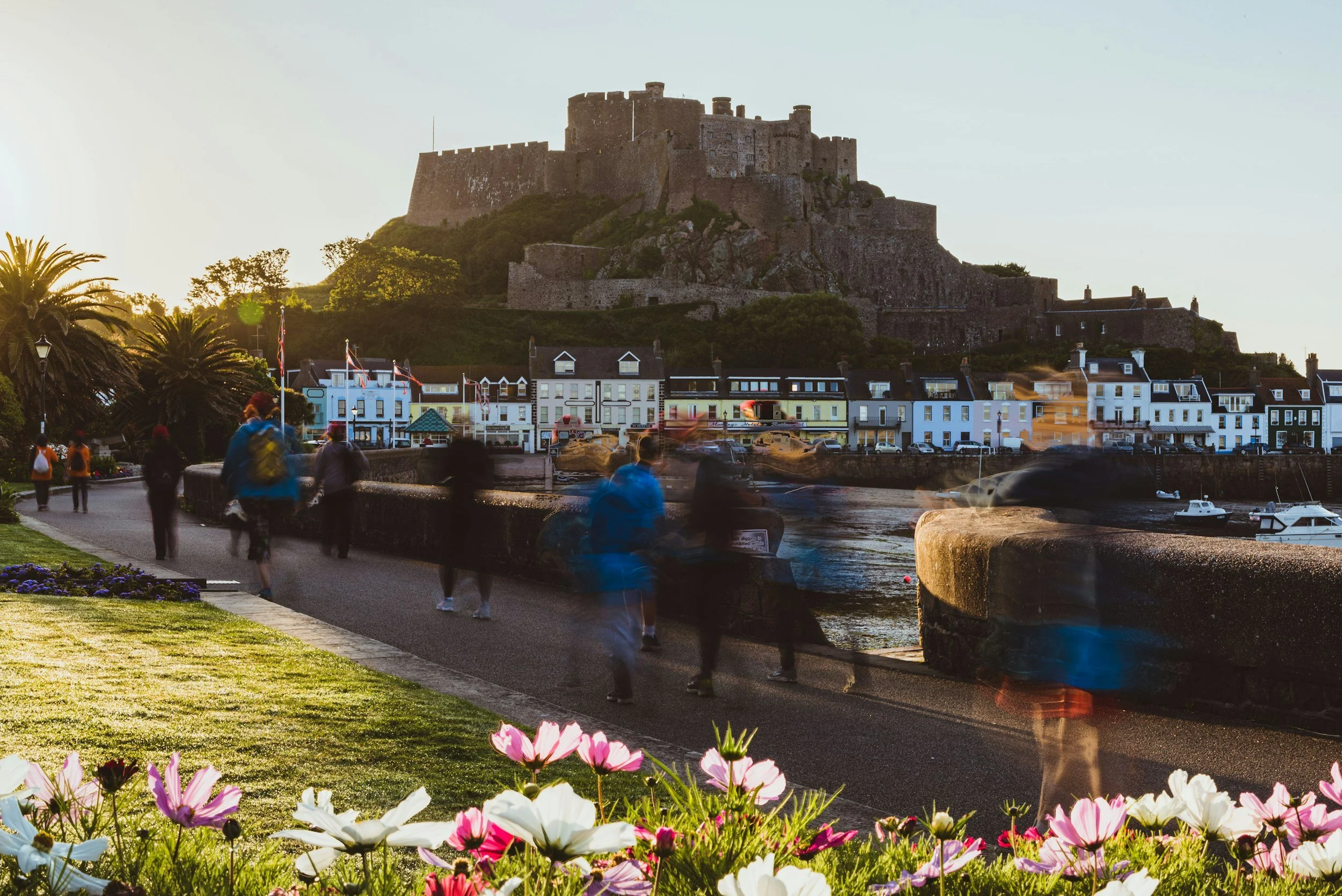
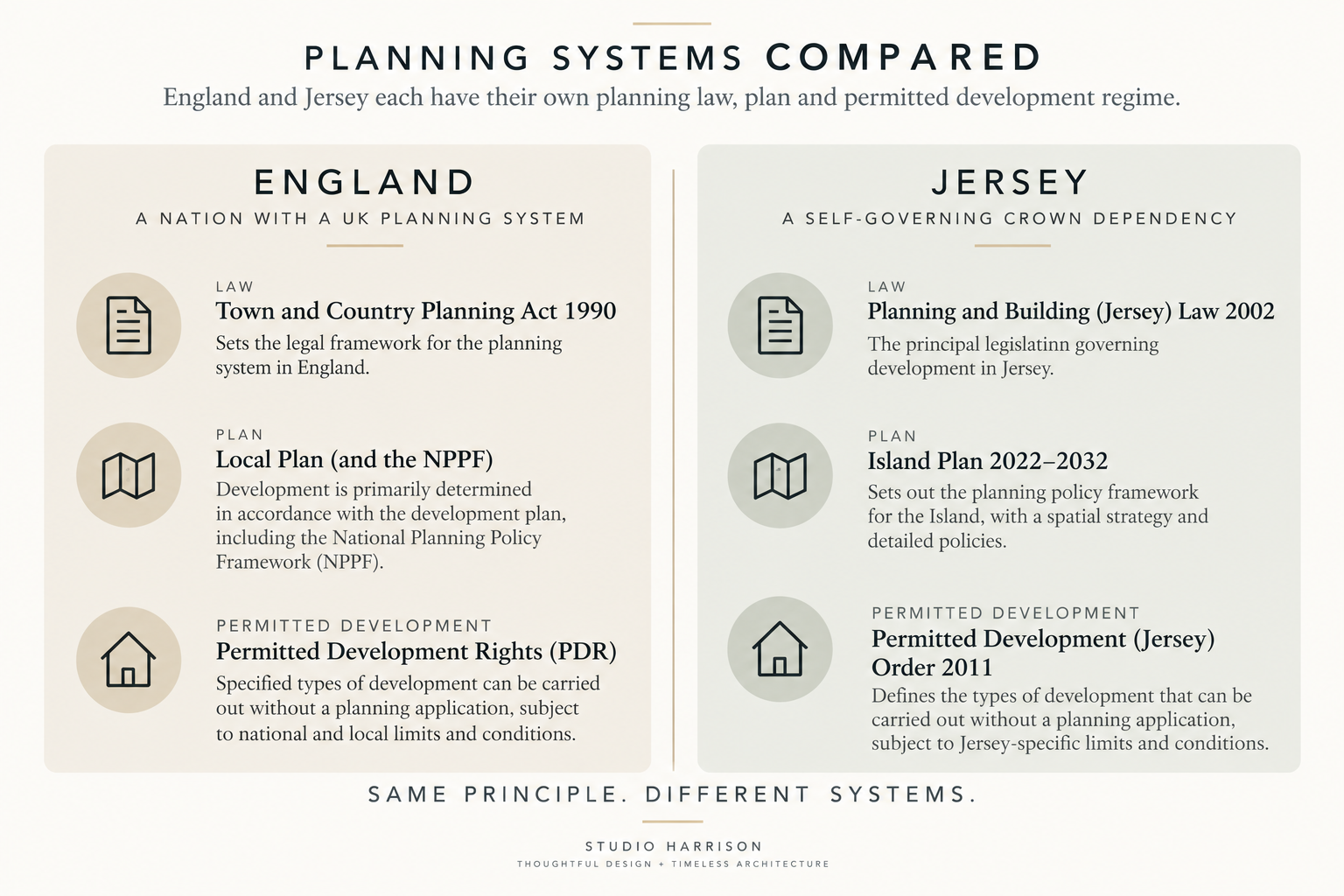
Jersey is not covered by the National Planning Policy Framework, and nothing published in Westminster changes what you can or can't build there. Jersey is a Crown Dependency with its own parliament, the States Assembly, and its own planning law — the Planning and Building (Jersey) Law 2002 — which has no formal connection to England's planning system at all. For anyone used to mainland planning, or advising a client moving between the two, that single fact explains most of the differences that follow.
We've written generally about building in Jersey before. This is the more specific companion piece: a direct comparison, for anyone genuinely trying to understand how the island's system differs in practice, not just in principle.
Is Jersey covered by the NPPF at all?
No, not in any form. The NPPF and the Town and Country Planning Act system apply to England; Jersey's internal affairs, including all planning and building control, are governed entirely by its own legislature. This means every NPPF change we've written about this week — the August 2026 rewrite, grey belt, the "evidenced unmet need" provision — is simply irrelevant on the island. Jersey has its own version of most of these questions, running on its own timetable, and conflating the two systems is the single most common mistake we see from clients or contacts arriving from the mainland.
What's the current development plan, and is a new one coming?
Jersey is currently governed by the Bridging Island Plan, adopted in March 2022 and originally intended as an interim measure ahead of a longer-term successor. As of now, it remains the primary planning document, because that longer-term plan hasn't yet been adopted — its timeline has slipped more than once, and the newly formed government elected in June 2026 has signalled it intends to amend the existing plan rather than wait years for a wholly new one. Jersey's new Minister for Planning and Regulation, appointed in July 2026 in a newly separated role, has been openly critical of the current plan's scope, and change of some kind looks more likely than not over the coming year or two — though nothing has been formally proposed as we write this. If you're planning a project on a longer timeline, this is worth watching rather than assuming the current plan will still read the same way in two years.
Does Jersey have permitted development rights?
Yes, and — helpfully — it's actually called that. The Planning and Building (General Development) (Jersey) Order 2011 grants automatic planning permission for a defined set of minor works, much as England's own General Permitted Development Order does. For a conservatory or single-storey extension specifically, the island's rules allow it without a full application provided it stays within set limits: no more than 30 square metres of external floor area, a maximum height of 3.5 metres to a pitched roof (or 3 metres flat), lower still near a boundary, built within the existing garden and reached from inside the house, and not in front of the property's principal elevation facing the road. Full planning permission is still required regardless of size if the property is listed, sits in an Archaeological Potential Area, would be visible from a road or the shore within a Conservation Area, or if a previous planning condition has already removed permitted development rights from the site.
Those figures are close in spirit to England's own permitted development limits, but they are not identical, and treating one set of numbers as a safe proxy for the other is a mistake worth avoiding.
Are Jersey's building standards the same as England's?
Related, but deliberately not identical, and not automatically updated in step. Jersey uses its own Building Bye-laws rather than England's Building Regulations, built on the same broad foundation — the island's own guidance describes using England's Approved Documents "as a basis" and adapting them for Jersey's needs — but reviewed on its own schedule. That matters directly for anyone assuming an English standard, like the Future Homes Standard due to take effect on the mainland in 2027, will automatically apply. It won't, unless and until Jersey's own review adopts something equivalent.
As it happens, that review is live right now. A Building Standards review running through 2025 and into early 2026 covered safety, net-zero and energy performance, and accessibility, with public input on all three now closed. It's been looking at questions including a possible move away from fossil-fuel primary heating in new buildings, encouraging or requiring solar provision, and tighter insulation and air-tightness standards — but nothing from that review has yet been formally adopted as updated bye-laws at the time of writing. Anyone designing a new home or a substantial extension in Jersey right now should treat this as a genuinely live area, worth a direct, current check rather than an assumption either way.

Who actually decides a planning application in Jersey?
This is one of the more interesting structural differences, and it's worth understanding even if you never intend to appeal a decision. Jersey has no separate tier of local councils for planning — the whole island sits under one planning department. Most applications, including the great majority of householder extensions, are decided by planning officers under delegated authority. Larger or more contested applications go to the Planning Committee, a group of nine elected States Members who meet monthly in public, and who must defer a decision to the following month if minded to approve against their own officers' recommendation. The most significant applications, and all appeals against refusal, are decided personally by the Minister for Planning and Regulation.
That last point is the genuine structural contrast with England. On the mainland, a council's planning committee and the independent Planning Inspectorate that hears appeals are institutionally separate bodies — a refusal by one is reviewed by an entirely different organisation. In Jersey, the same Minister who oversees the planning department also personally decides appeals against that department's own refusals, informed (but not bound) by an independent inspector's recommendation. It's a smaller, faster system in some respects, and a structurally different one in this particular respect, worth knowing if a project ever reaches that stage.
What about Jersey's coast and countryside?
Jersey has its own layered set of landscape protections, similar in spirit to England's but legally distinct. Most development is directed toward the island's Built-up Area. Beyond that, the Green Zone protects countryside with a largely intact landscape character, in a manner loosely comparable to Green Belt without being the same legal mechanism. The island's highest tier of protection is the Coastal National Park, covering roughly 1,925 hectares of the south-west headlands, St Ouen's Bay, much of the north coast, and other stretches of coastline — a Jersey-specific designation, established through the 2011 Island Plan, that functions similarly to an English National Park without being one in the formal UK sense. A separate, adjoining Protected Coastal Area, introduced in 2022 after a proposal to extend the Park itself met local opposition, gives a further band of coastal land the same high level of protection under a different name. Listed buildings, conservation areas and archaeological sites all restrict permitted development rights in Jersey too, much as their English equivalents do.
Frequently asked questions
If I have planning permission experience in England, does it transfer to working in Jersey?
The underlying design thinking does; the regulatory knowledge largely doesn't. The legal framework, the development plan, the permitted development limits and the decision-making structure are all genuinely different, which is exactly why a Jersey project benefits from a design team who already know the island's system rather than one applying mainland assumptions to it.
Is it harder or easier to get planning permission in Jersey than in England?
Neither, reliably — it's simply a different system, with its own priorities around housing need, landscape and heritage. What matters more than a general "easier or harder" comparison is understanding the specific policy your project falls under.
Does the Future Homes Standard apply in Jersey?
Not automatically. Jersey sets its own building energy standards through its own Building Bye-laws, currently under review, rather than inheriting English standards directly.
Can I convert an existing Jersey property without full planning permission?
Sometimes, depending on the works involved and whether the property is listed or in a protected area — the same general principle as England, but governed by Jersey's own permitted development order rather than England's.
Who do I appeal to if a Jersey application is refused?
In the first instance, to the Minister for Planning and Regulation, who decides appeals personally, advised by an independent inspector. Beyond that, a further challenge goes to the Royal Court, Jersey's senior court, rather than to a second planning tribunal.